OpenAI launches MedChemBench to test AI in medicinal chemistry
OpenAI has introduced MedChemBench, a benchmark of 99 tasks based on 117 scientific papers and patents involving 761 molecular structures. It evaluates how AI models reconstruct molecules, explain experimental results, rank compounds and predict properties. OpenAI’s GPT-6.2 Astra scored 84.5 percent, while GPT-5.6 Sol scored 58.2 percent. OpenAI says the results do not prove AI can independently discover drugs.
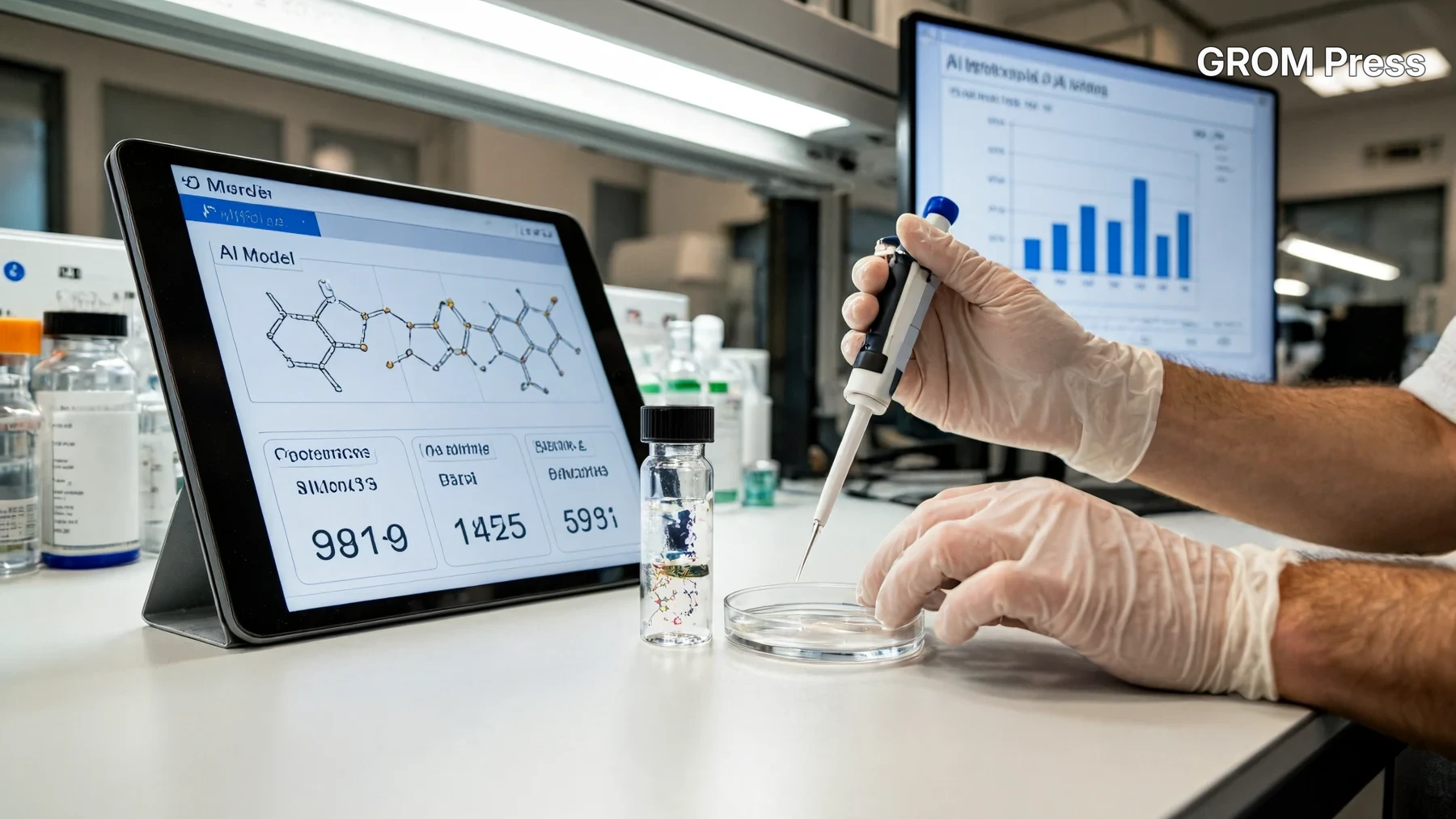
OpenAI has presented MedChemBench, a benchmark designed to assess how well artificial intelligence models handle tasks from medicinal chemistry, the field involved in finding and developing drug-like compounds. The benchmark contains 99 tasks compiled from 117 scientific articles and patents, with 761 molecular structures featured across them. In most tasks, a model receives information available to researchers at a particular stage of a study, including the biological target, research goals, previously studied compounds and results of earlier experiments, and must draw conclusions from those data.
The benchmark evaluates four areas: correctness of molecular structure reconstruction, scientific justification of conclusions, compound ranking and selection, and prediction of compound properties. OpenAI notes that property prediction is especially difficult because characteristics can conflict, for example when a compound effectively inhibits a disease-related protein but poorly penetrates cell membranes or breaks down too quickly under liver enzymes.
One example is based on research into PRMT5 inhibitors, a protein studied in the context of anticancer drug development. Models were asked to predict properties of three related compounds: how effectively they suppress the protein in cells, how well they cross the cell barrier, and how quickly they are degraded by liver enzymes. Subsequent experiments showed a trade-off among the characteristics: compound 23 inhibited PRMT5 more strongly, while compound 24 crossed the cell barrier better and degraded more slowly.
According to OpenAI’s own testing, GPT-6.2 Astra received 84.5 percent of available points at the maximum reasoning level for comparison, xhigh. GPT-6 Astra scored 83.3 percent, GPT-6.1 Sol scored 82 percent, and GPT-5.6 Sol scored 58.2 percent. Results varied by category: GPT-6.2 Astra received 95.4 percent of points for molecular structure reconstruction but only about half of the possible points for compound selection and prediction of numerical characteristics.
OpenAI emphasized that these results do not prove AI can independently discover drugs or improve decisions made in laboratories. Each model answered the tasks once, without additional tools, feedback or new experiments. Therefore, MedChemBench currently evaluates work with already known scientific data rather than the ability to conduct real drug development.
Source: GROM.PRESS