NASA experiments show Venus minerals could preserve traces of ancient water
NASA's Glenn Extreme Environment Rig exposed six rock-forming minerals to Venus-like conditions for 60 days. Fluorine-bearing micas formed from hydroxyl-rich micas and may survive surface temperatures, while brucite converted partly to magnesite. Sulfur-bearing layers formed on all samples. The findings could guide NASA DAVINCI, VERITAS and ESA EnVision missions, but do not prove that Venus once had water.
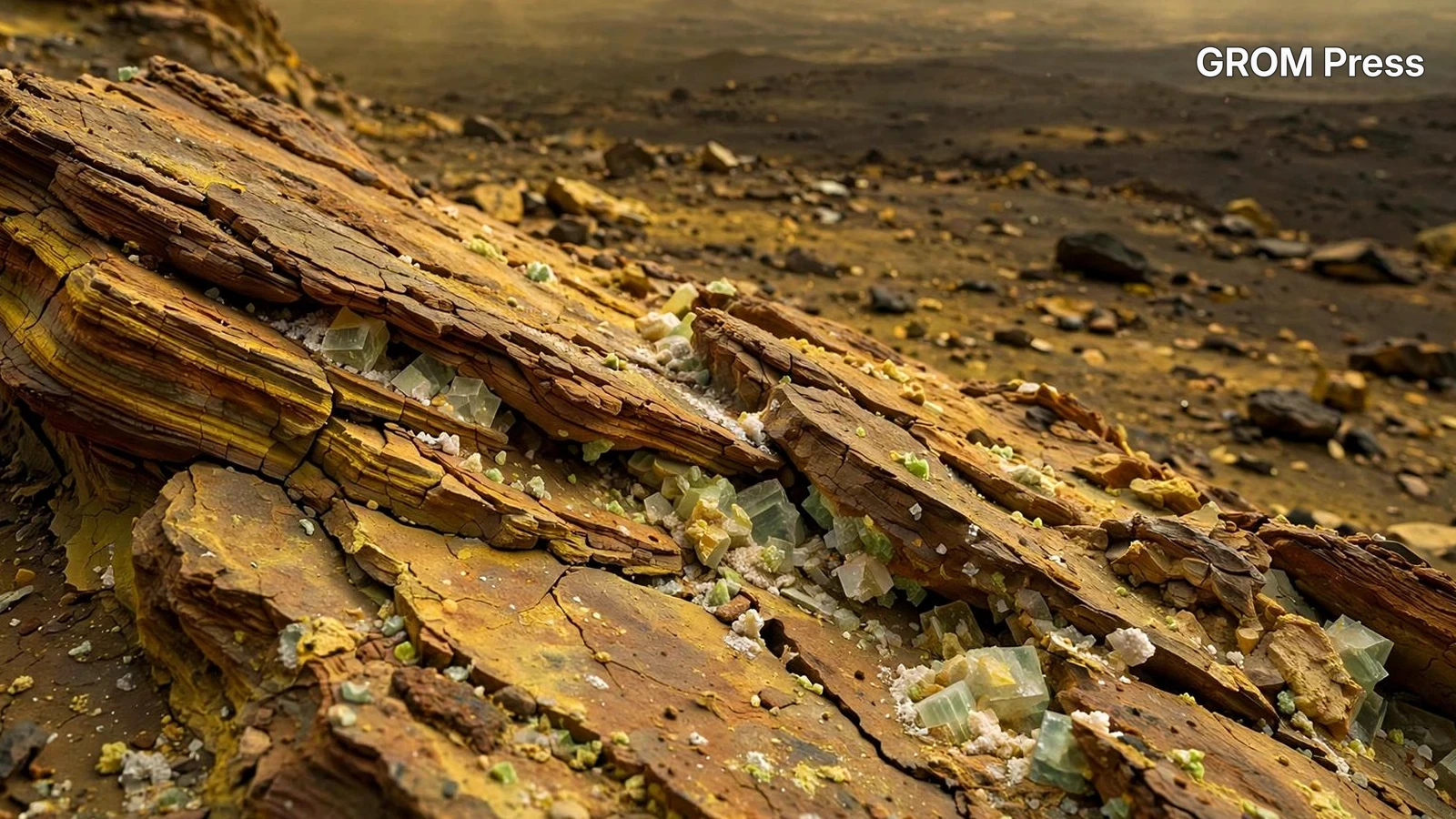
Experiments conducted by researchers from the University of Texas at San Antonio, NASA and Arizona State University tested whether minerals bearing evidence of water could survive long-term exposure to Venus's atmosphere. Six rock-forming minerals were exposed for 60 days in the Glenn Extreme Environment Rig at NASA's Glenn Research Center, a chamber with a volume of 811 litres that reproduces Venusian temperature, pressure and atmospheric chemistry. Surface temperature on Venus reaches 460 degrees Celsius and pressure is 93 times Earth's. After the experiment, samples were analysed using equipment at Arizona State University.
The most important result involved gaseous hydrogen fluoride reacting with hydroxyl-bearing micas, phlogopite and muscovite. The gas replaced hydroxyl groups in the mineral structures with fluorine atoms, producing fluorophlogopite and fluoromuscovite. These mica varieties have increased thermal stability; fluorophlogopite can persist at temperatures up to 1100 degrees Celsius. The researchers said this means Venusian atmospheric chemistry can transform water-bearing minerals into more resistant compounds rather than only destroying them.
Phlogopite and muscovite form in geological processes involving fluids, so their presence on Venus could indicate wetter conditions in the past. If such minerals formed long ago, replacement of hydroxyl groups by fluorine could have helped them survive on the surface. The experiment does not prove that ancient water existed on Venus; it shows a possible mechanism for preserving mineralogical evidence.
Brucite, a mineral containing hydroxyl groups, lost water under high temperature and turned into magnesium oxide, which then reacted with carbon dioxide to form magnesite, a magnesium carbonate. The reaction was not complete after 60 days, but magnesite formation was confirmed. The authors also reported the first detection of sellaite, a magnesium fluoride mineral, in an experiment simulating Venusian conditions.
Thin sulfur-bearing layers formed on the surface of all studied minerals, showing that sulfur dioxide from the atmosphere actively interacts with rocks. The authors calculated that maintaining observed concentrations of sulfur dioxide and hydrogen fluoride may require continuous delivery of new volcanic gases and fresh material to the surface. Thus, minerals could reveal both a possible watery past and current volcanic processes on Venus.
The results may help prepare observations for future NASA DAVINCI and VERITAS missions and the European EnVision mission. If these spacecraft detect fluorine-bearing micas or magnesite on Venus, these minerals could become strong markers for studying Venus's history and surface-atmosphere interaction.
Source: GROM.PRESS